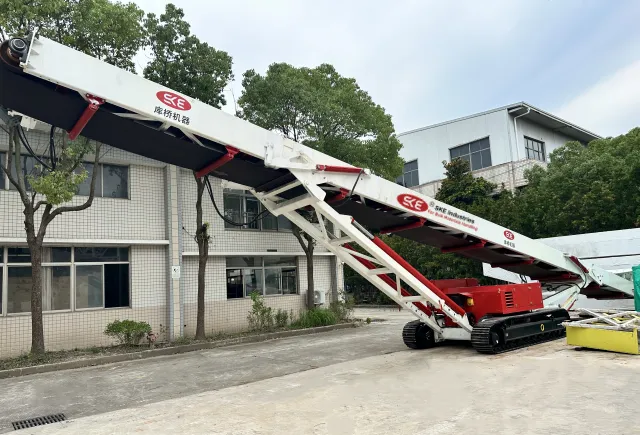
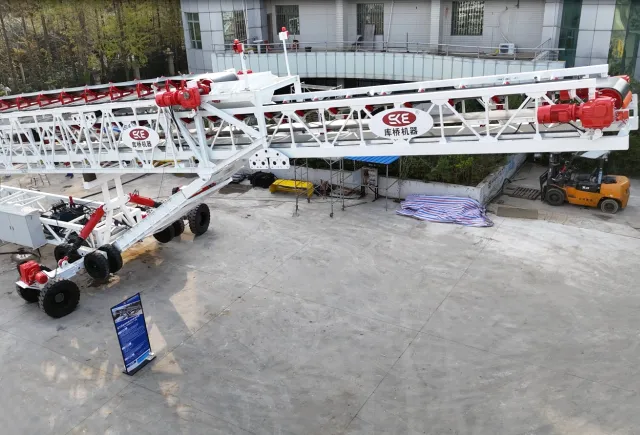
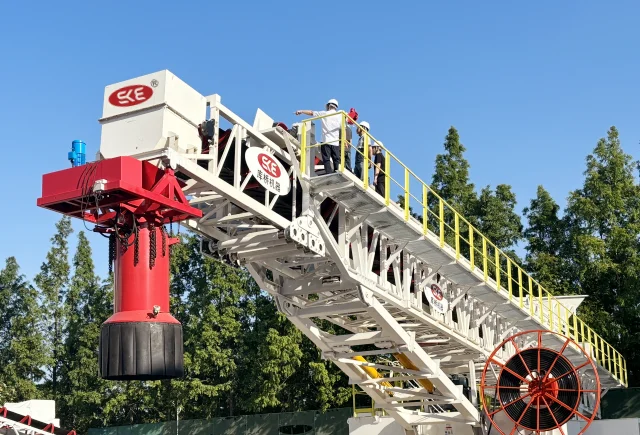
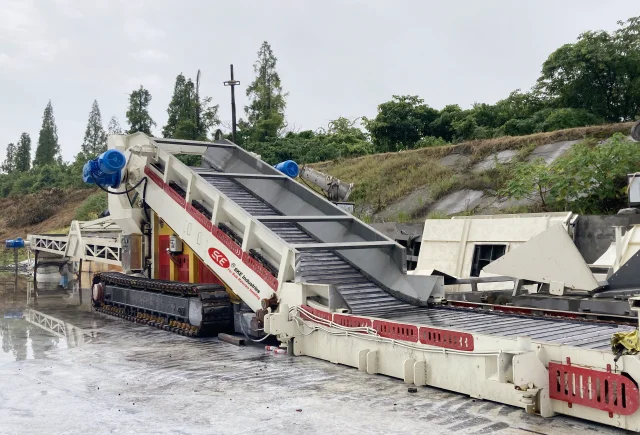
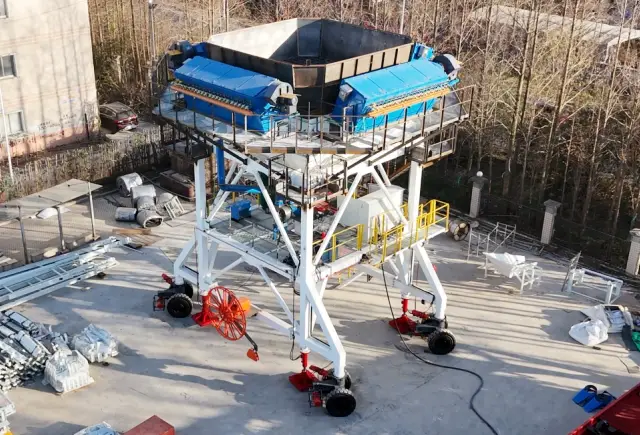
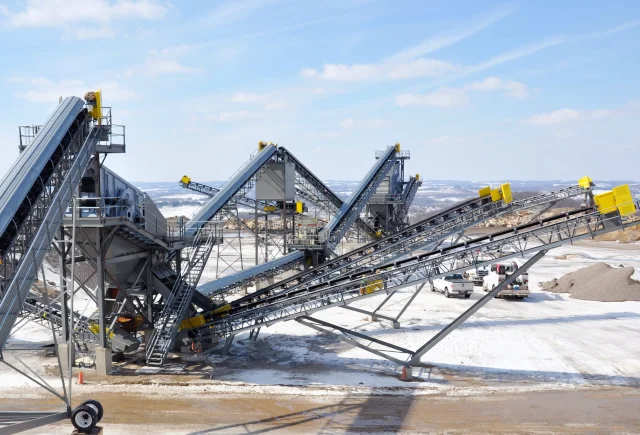
Bulk shiploaders come in various configurations. For sensitive materials like grains, the choice of equipment is constrained by factors such as breakage rate, operational efficiency, energy consumption, noise levels, investment costs, and environmental considerations. This article systematically reviews four major types of grain shiploaders, analyzing their structural features, applicable scenarios, and pros and cons.
1. Tower Transfer + Fixed Boom Shiploader
Widely used in major grain-producing countries like Brazil.
Structural Features
- Utilizes a conveyor belt transfer system
- Fully enclosed transfer towers (steel or concrete construction)
- Typically 3-4 transfer towers (depending on vessel length and conveyor incline angle)
- Fixed-length boom with hydraulic swing and adjustable discharge chute
- Standard rotation of 180° (some designs allow 270° for dual-side loading)
Advantages
- No downtime during hold switching, ensuring high efficiency
- Simple system layout and compact terminal design
- Lower capital investment
- Minimal maintenance due to fixed structure
- Excellent dust containment and environmental performance
Limitations
- Fixed loading range limits vessel adaptability
- Multiple transfer points increase failure risks
- Single-point failures can disrupt entire operations
2.Mobile Tail-Mounted Shiploader
Material flows from the rear belt conveyor → tail-mounted tripper car → boom front → discharge chute into the hold. Adjustable loading position via boom luffing, slewing, chute extension, and machine travel.
Features
- Continuous high-efficiency operation
- Strong adaptability to varying hold sizes and water levels
Challenges
- Complex steel structure, difficult installation
- Long rail occupation, limiting terminal capacity
- High transfer points extend terminal length
- Brief pauses required during hold switching (unless buffer bins are added)
Innovative Design
- Replaces tail-mounted systems with mobile carts, plough feeders, or throw-off devices.
- Connects to mobile ship loaders via inclined chutes.
- The combination of truck unloader and mobile ship loader is becoming increasingly common.
Variations
- Mobile conveyor: Suitable for small vessels with low freeboard, offering high flexibility
- Simplified version: Direct chute-to-vessel loading (for small ships but with dust issues)
Advantages
- Eliminates complex tail structures
- Reduces trestle height
- Shortens terminal length
Drawbacks
- Requires operational pauses during repositioning
- Lower efficiency
Adds a bucket elevator system to traditional mobile shiploaders, comprising traction components, buckets, drive units, etc.
Key Benefits
- Significantly reduces tail trestle and transfer station height
- Shortens material transport distance
- Decreases terminal space occupation
- Superior sealing performance
Special Application
- Innovative truck-fed + bucket elevator design (though less efficient than conveyor systems)
Technical Challenges
- High stability requirements for elevators
- Demanding precision in upstream/downstream connections
Comprehensive Comparison
| Type |
Efficiency |
Adaptability |
Investment |
Maintenance |
Eco-Friendliness |
Best For |
| Tower Fixed |
High |
Medium |
Low |
Low |
Excellent |
Large-scale, fixed vessels |
| Mobile Tail |
High |
High |
High |
Medium |
Good |
Multi-vessel flexibility |
| Fixed + Mobile |
Medium |
Good |
Medium |
Medium |
Moderate |
Small/medium vessels |
| Bucket Elevator |
Medium-High |
Good |
Medium-High |
High |
Excellent |
Space-constrained terminals |
The selection of grain shiploaders should consider terminal conditions, vessel types, operational requirements, and budget constraints. Future trends will focus on intelligent control, energy efficiency, and modular designs to enhance productivity and adaptability.
Related Articles