
Stacker, Ship Loader, Eco Hopper, Reclaimer, Truck Unloader, Belt Conveyor Manufacturer

SKE Industries is a professional manufacturer of mobile ship loaders and ship loading conveyors, offering flexible and mobile ship loader conveyors for bulk materials handling in ports and terminals. Our mobile shiploaders are designed for loading dry bulk materials onto various vessel types, including Barges, Handymax, Panamax, Supramax, and Capesize ships. The mobility of these ship loading conveyors allows easy relocation within ports to different berths and locations, offering versatility in loading vessels.

The all-wheel travel mobile shiploader is mounted on all-wheel travelling undercarriage with radial and telescopic features, and it can be fed by mobile hopper feeder, truck unloader, fixed conveyor and grasshopper conveyor.

The radial telescopic shiploader can allow you to load multiple hatches from one feed-in position. This mobile ship loader can be mounted on tracks or wheels and fed by mobile feeders, truck unloaders, fixed conveyors and grasshopper conveyors.

The rail mounted shiploaders allow the unit to move easily parallel down the quayside. This mobile ship loader suits for ship sizes ranging from barges to Panamax. The ship loading capacity can reach 3000 t/h.

The direct feed ship loader is widely used in loading barges and coaster vessels. This mobile ship loader can be fed by wheel loaders, crane grab, and excavator. The ship loading capacity can reach 1500t/h.

This is a types of bulk reception feeders and it can be used as shiploader for loading barges and coasters in port and in-land terminals. The ship loading capacity can reach 1500t/h.

The cambered boom mobile shiploader offers flexible solutions for every loading application with loading capacity up to 2000 t/h. It uses all-wheel travelling unit to move freely around the dock.
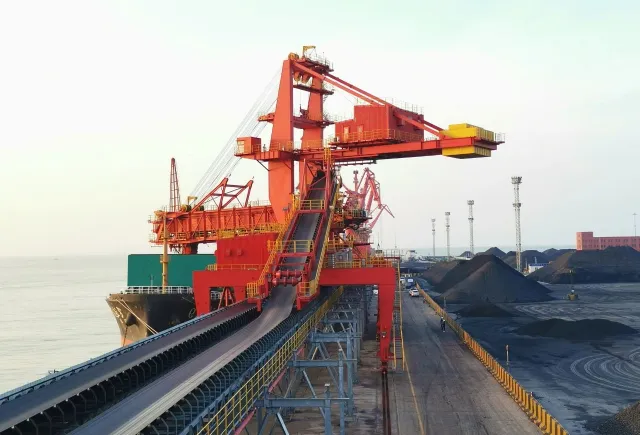
The continuous ship loader is a continuous machine used for bulk cargo loading operations and is connected to the rear conveyor system. Our continuous ship loaders able to load bulk carriers up to 120,000 DWT at rates of up to 6000 t/h.
Our mobile ship loaders are mainly used to load bulk materials into bulk carrier vessels. We offer complete solutions of mobile ship loading conveyor, barge loading conveyor, and vessel loading conveyor. The most common shiploaders are used in ports to handle bulk materials like these:


Our mobile shiploaders are also types of mobile barge loaders. They are all developed by our rich experienced engineers. It ensures unrivalled flexibility when loading a bulk vessel. You can use our barge loading conveyor to load bulk carriers.
| Bulk Vessel Type | The Capacity of Bulk Carriers |
| Barge | Capacity: 100-5,000(DWT), Clearance Height: 0-10'(0-3m), Length: 15-130m |
| Coaster | Capacity: 500-6,000(DWT), Clearance Height: 6'7''-19'8''(2-6m), Length: 15-130m |
| Handysize | Capacity: 10,000-35,000(DWT), Clearance Height: 13'-26'(4-8m), Length: 130-150m |
| Handymax | Capacity: 35,000-50,000(DWT), Clearance Height: 20'-33'(6-10m), Length: 150-200m |
| PANAMAX | Capacity: 60,000-80,000(DWT), Clearance Height: 33'-46'(10-14m), Length: 200-230m |
| CAPESIZE | Capacity: 80,000-120,000(DWT), Clearance Height: 52.5'(16m), Length: 230-270m |
In order to provide reasonable ship loader for handling bulk materials, we need some dimensions of the bulk material vessel and the port. You can find the items below or ask for a form to fill from our seller. As a mobile ship loader manufacturer, we can offer customized equipment for you.
| Project Data of Port and Ship | |
| 1. Bulk Vessel Type | 9. Beam Width |
| 2. Total Load Capacity (DWT) | 10. Hatch Width |
| 3. Overall Length | 11. Deck Width |
| 4. Minimum Draft For Vessel | 12. Fender Width |
| 5. Maximum Draft for Vessel | 13. Free-board Above Quay |
| 6. Ground Pressure Requirement | 14. Available Quay Width |
| 7. Dock Height Above Water (High Tide) | 15. Ship Height (Main Body) |
| 8. Dock Height Above Water (Low Tide) | / |
A mobile ship loader, a high compact mobile conveyor system, that loads dry bulk into a ship or barge and can be moved off the berth. It is an alternative to a fixed shiploader or a grab crane, when loading bulk material into ship holds..
A traditional ship loader is right when one berth loads the same cargo, at a very high rate, for years. For most other terminals we recommend a mobile unit. It loads continuously, civil work is much smaller, and we can install it in days rather than months. When the berth is free we move it aside, send it to another berth, or use it to build a stockpile. It can also cover a fixed stacker-reclaimer while that machine is down.
We keep the tail on the feed point. The boom slews, and the inner conveyor runs out into the hold. On a typical radial telescopic loader we can trim about three hatches before the feeder has to move. The extending section also lets us pass the cranes on a geared ship. On some berths we load four or five hatches without shifting the vessel at all.
On an all-wheel machine we steer in crab, radial, carousel, inline, or parallel. Some units use radial, parallel, and tow. We can reposition along the quay without taking the machine apart. That is what we specify when one loader has to serve more than one berth. If the ground is soft, we put it on tracks. If the quay has rails, we put it on rails and still telescope the boom.
We discharge through a telescopic chute or a cascade chute. Feed and transfer points are sealed. If the cargo needs it, we add extraction, water suppression, or both. For trimming we use a cascade chute, a variable-speed thrower, or a distributor. The operator stands at the hatch with a radio remote and watches the pile, rather than guessing from a cabin far away. Some chutes are a light telescoping tube that does not plug easily, and we can raise them automatically as the hold fills. Covers are steel, canvas, or retractable. Spill trays and liners inside the spout keep the quay clean.
Shore power if you have it. If the loader has to roam, we fit a diesel set or a diesel-electric drive. Travel, luff, and telescope are usually hydraulic. One thing we always check: a generator sized only to move the machine will not run the belt at full rate.
The loading capacity depends on belt width and the material. Radial telescopic and rail-mounted: up to 3,000 t/h. Cambered boom ship loader: up to 2,000 t/h, belt 1,000 / 1,200 / 1,400 mm.
The our mobile ship loader working length is fully extended up to 58 m (190 ft). We can also provide customized working boom length for larger ships.
SKE Industries's mobile ship loading conveyor equipment has a very strong advantage than traditional ship loader.
Faster lead times compared to fixed systems requiring excessive engineering. Significantly lower capital investment than highly engineered and fixed ship loader conveyor system.
Installation times of mobile barge loading conveyor measure in hours and days versus weeks or months. The mobile barge loader needs small footprint that creates more dock space for other opportunities.
Highly mobile shiploaders can rapidly move in and out of your operation. Multi-functional machinery performs loading, unloading and stockpiling tasks.
SKE's mobile shiploaders have high resale value, even increasing over time. Quality of bulk material maintained throughout the loading conveyor handling process by our mobile ship loading conveyor equipment.


